ISSB Preparation Guide

The ISSB is the deciding stage for anyone hoping to become an officer in the Pakistan Army, Navy, or Air Force. Each branch offers different types of commissions, and even some Short Service Commission entries now make ISSB mandatory.

Candidates can prepare for every stage of the ISSB with complete, hands-on practice here. If you want a real understanding of your personality traits and whether you are truly fit to lead as a Pakistan Armed Forces officer, our psychologists assess you against every parameter the ISSB itself looks for.

ISSB Selection Process

Day 1

REGISTRATION & SCREENING

Registration

Complete your reporting formalities and receive your ISSB schedule.

Document Check

Submit your original certificates, CNIC/B-Form, photographs, and other required documents.

Orientation

Attend the briefing about ISSB rules, discipline, daily routine, and testing procedures.

Day 2

Psychological Assessment

Written Tests

Complete intelligence, verbal, and non-verbal reasoning tests.

Personality Evaluation

Attempt WAT, Sentence Completion, Self-Description, and Picture Story Writing.

Psychologist Interview

Answer questions honestly to help assess your personality and officer-like qualities.

Day 3

GTO
Group Testing

Group Discussion

Discuss assigned topics while demonstrating confidence and teamwork.

Planning Exercise

Work with your group to solve practical situations and present solutions.

Outdoor Tasks

Participate in Progressive Group Task (PGT), Half Group Task (HGT), and other obstacle activities.

Day 4

Interview & Leadership Tests

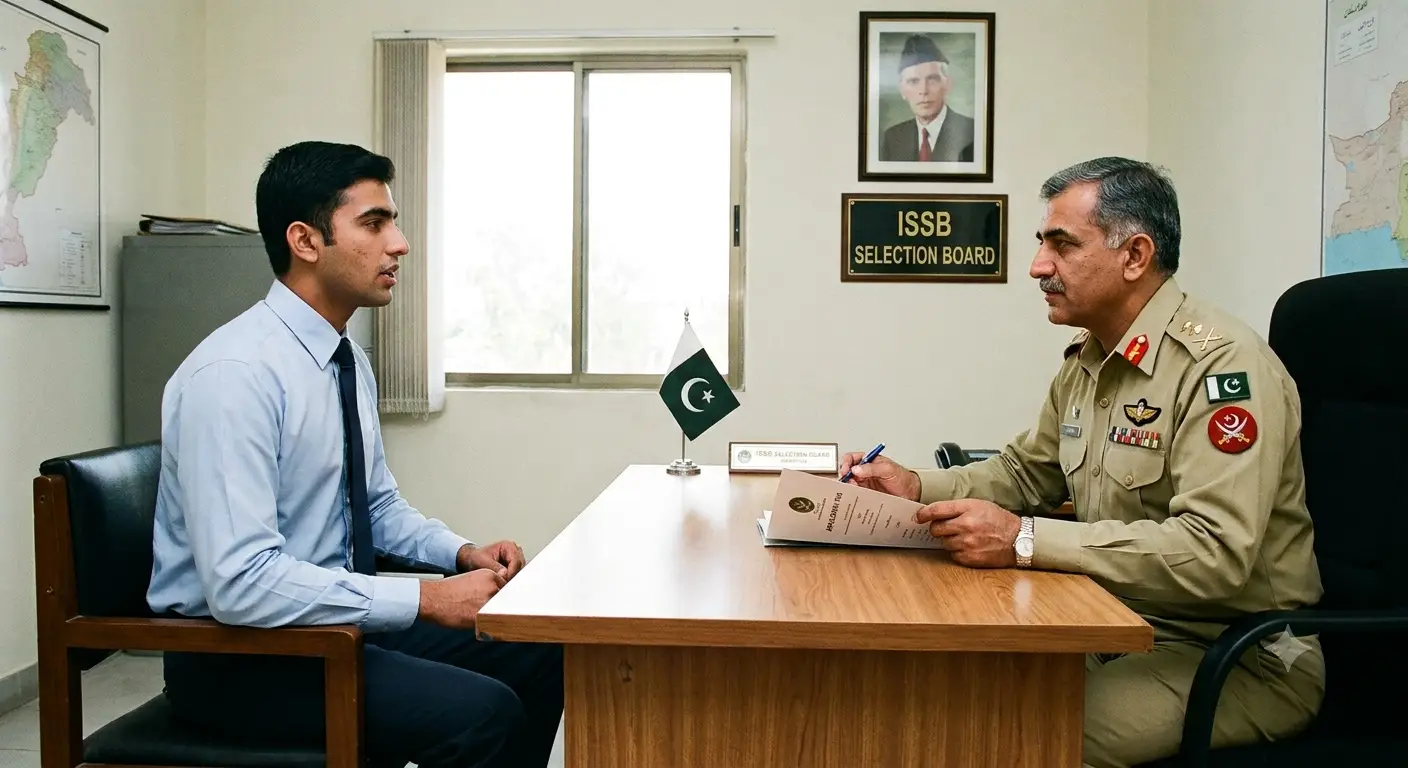
Personal Interview

Meet the Deputy President or Interviewing Officer for a detailed interview.

Command Task

Lead your assigned team through a practical task while making decisions.

Individual Obstacles

Complete physical obstacles within the given time to demonstrate fitness and determination.

Day 5

Final Results & Departure

Conference

Appear before the ISSB panel for a short final interaction.

Recommendation

Successful candidates receive recommendations for further medical examination.

Departure

Complete clearance procedures and return home after the ISSB process concludes.

GTO Assessment

GTO tests evaluate teamwork, leadership, communication, planning, and decision-making through a series of individual and group activities.

Group Discussion

Lecturette

Planning Exercise

Obstacle Course

Individual Obstacles

Command Task

Progressive Group Task

Half Group Task

Final Group Task

ISSB Interview

Interview Questions

General Knowledge

Questions about Pakistan, defence, geography, history and important national topics.

Current Affairs

Questions about recent national and international events, defence and important developments.

Family Background

Questions about your family, background, responsibilities and personal life.

Education

Questions about your academic background, subjects, interests and achievements.

Personal Questions

Questions about your personality, strengths, weaknesses, hobbies and career goals.

ISSB Interview

Prepare for Your ISSB Interview

Stay confident, answer honestly, and prepare yourself for questions about your personality, education, family and current affairs.

ISSB TIPS

What You Should Do

Be Natural in Psychological Tests

Answer naturally in WAT, Sentence Completion, and Picture Story. Your responses help the Psychologist understand your personality.

Participate in Group Discussion

Share useful ideas, listen to others, and speak confidently but do not copy others.

Work as a Team

Show Teamwork in GTO Tasks. Cooperate with your group during PGT, HGT, and Group Planning.

Take Initiative in Command Tasks

Understand the task, make decisions, and guide your team clearly.

Give Your Best in Physical Tasks

Stay active and keep trying during Individual Obstacles and other tasks.

Improve General Knowledge

Read about Pakistan, current affairs, defence, geography, history, and important national events.

Manage Your Time

Complete tasks within the given time and avoid spending too long on one question or activity.

Avoid These Mistakes

Inconsistent Answers

Keep your answers honest and consistent in the PIQ Form, Psychological Tests, and Interview.

Losing Composure

Stay calm and focused during SRTs, GTO Tasks, and difficult situations.

Dominating the Group

Don’t interrupt, argue, or force your opinion during Group Discussions and GTO activities.

Giving Up Easily

Show effort and determination during Individual Obstacles and other Physical Tasks.

Don't Panic Under Pressure

Stay calm and focused during difficult GTO and Physical Tasks.

Frequently Asked Questions

1. How long does the ISSB testing process take?

The ISSB assessment normally involves a 5-day stay at centers such as Kohat, Gujranwala, Malir, or Quetta. Candidates usually report on Day 0 and leave on the afternoon of Day 4 after the final assessment and results.

Intelligence Tests, including Verbal and Non-Verbal Tests, are generally conducted at the Initial Selection Centers before ISSB. The ISSB assessment mainly focuses on Psychological Tests, GTO activities, and Interviews.

There is no officially published fixed passing percentage for the Mechanical Aptitude Test (MAT). The test helps assess a candidate's technical aptitude and may be relevant to technical fields such as Engineering and GD(P).

Candidates are generally allowed two ISSB attempts. However, reappearance rules can depend on the specific entry, course, and eligibility requirements, so candidates should check the rules for their particular application.

The GTO assessment includes activities such as Group Discussion, Group Planning, Progressive Group Task (PGT), Half Group Task (HGT), Command Task, and Individual Obstacles.

A change of ISSB test date may be considered in genuine emergencies, such as medical issues or examination conflicts. Candidates should contact GSO-2 Selection at the concerned ISSB center and provide supporting documents.

Mention your real strengths and weaknesses. Your merits can include qualities such as leadership, responsibility, or integrity, while your demerits should be genuine areas you are trying to improve. Avoid using unrealistic weaknesses such as “I work too hard.”

English is generally preferred during Group Discussion because communication skills are part of the assessment. If you have difficulty expressing a point, you may use Urdu briefly and then continue in English.

Not completing one or two Individual Obstacles does not automatically mean rejection. However, making a strong effort to complete the obstacles within the given time can demonstrate physical fitness, courage, determination, and stamina.

You can check your ISSB result/status through the official ISSB website or the relevant result portal when available. You may need details such as your CNIC and Batch ID to access your result.

Ready for ISSB?

Start your preparation today and take the next step toward your ISSB goal.